

Successful companies do not automatically create personal wealth. The most effective wealth-building strategies for business owners involve intentionally converting business income into assets that support long-term financial security, retirement goals and financial independence. Without a plan, it is possible to spend years growing revenue and profits without building meaningful wealth outside the business.
Wealth-building strategies for business owners go beyond generating income. It means creating a strategy that moves money from your company into investments and assets that can support your family, future goals and the lifestyle you want over the long term.
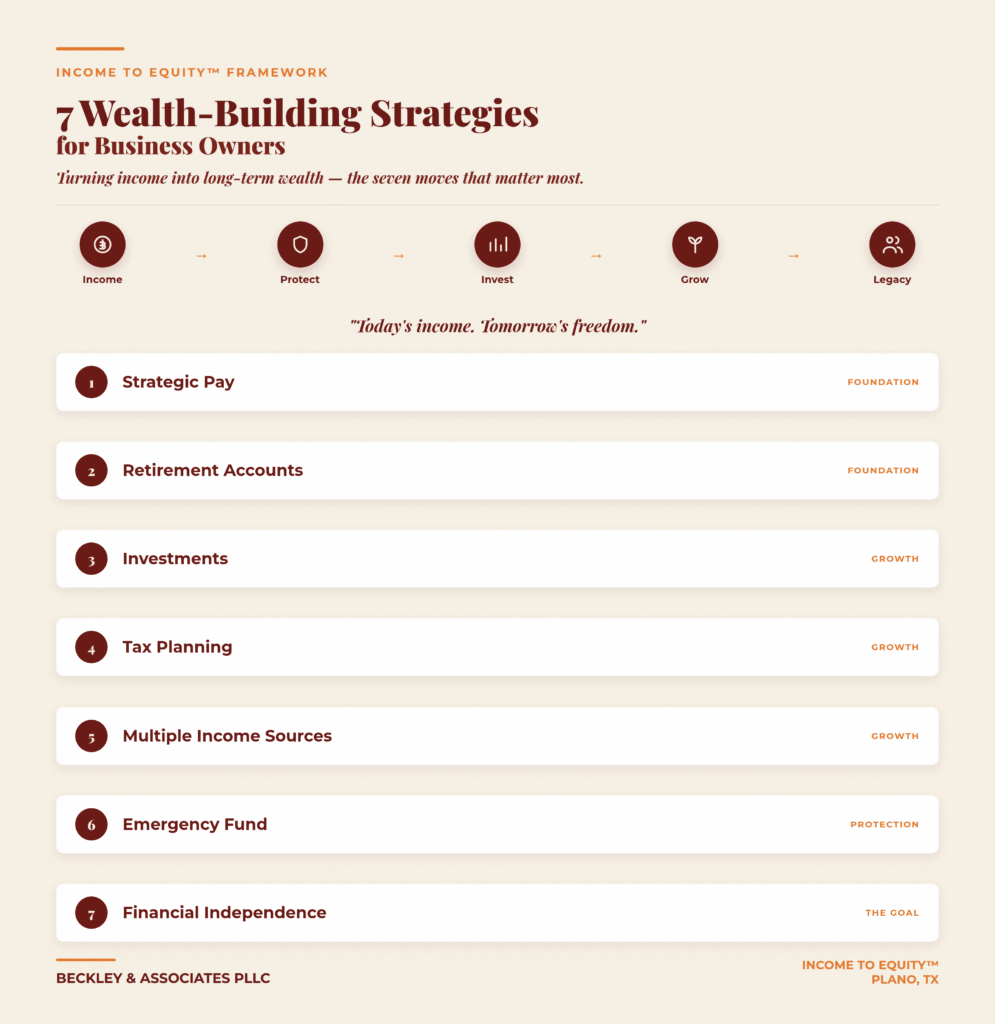
Here are seven wealth-building strategies that can help turn today’s business income into lasting personal wealth.
Explore More:
1. Pay Yourself Strategically
Business owners often focus on reinvesting every available dollar back into the company. While growth is important, continually delaying personal wealth accumulation can leave your future overly dependent on your business.
A thoughtful compensation strategy allows you to balance business growth with personal financial goals. Depending on your entity structure, this may involve a combination of salary and owner distributions.
The objective is not simply generating profits. The objective is ensuring those profits eventually become personal assets.
For S corporation owners, compensation planning should also account for reasonable compensation rules before relying on owner distributions.
Determining the right balance between salary and distributions can have important tax and financial implications. Learn more about this to inform your wealth-building strategies in our article, Owner Compensation for Business Owners.
2. Maximize Tax-Advantaged Retirement Accounts
Retirement plans remain one of the most powerful tools available for business owner wealth building.
Options may include:
- SEP IRAs
- Solo 401(k) plans
- SIMPLE IRAs
- Cash balance plans
These plans may provide tax-deferred, tax-deductible, Roth, or other tax-advantaged treatment depending on the plan design, contribution type, eligibility rules and the owner’s facts.
Our article, SEP IRA Explained: Smart Retirement Planning for Business Owners, provides additional information about how these plans work.
According to the IRS, self-employed individuals have several retirement plan options that can provide significant tax benefits and long-term savings opportunities. Please note that Solo 401(k)s are generally for owner-only businesses or businesses covering only the owner and spouse.
3. Build Investments Outside Your Business
For many entrepreneurs, their company represents the majority of their net worth.
While that may seem logical, it can also create unnecessary concentration risk.
According to Investor.gov, diversification and proper asset allocation are important principles for managing investment risk and avoiding excessive dependence on any one investment.
FINRA also highlights diversification as one of the foundational elements of long-term investing and wealth accumulation.
Examples may include:
- Brokerage accounts
- Stocks and bonds
- Exchange-traded funds
- Mutual funds
- Real estate investments
The Securities and Exchange Commission notes that diversification is one of the most important ways investors can manage risk. Please note that diversification can help manage concentration risk, but it does not eliminate investment risk or guarantee returns.
Your business should be one part of your wealth strategy, not your entire wealth strategy.
4. Maintain a Personal Emergency Fund
Business owners often maintain operating reserves for their companies while neglecting their own personal liquidity.
Having readily available personal savings can help you:
- Navigate periods of reduced business income
- Handle unexpected expenses
- Reduce financial stress
- Take advantage of opportunities when they arise
Personal reserves provide flexibility and peace of mind, especially during economic uncertainty.
5. Use Tax Planning to Keep More of What You Earn
Increasing income is only part of the wealth equation. Keeping more of what you earn matters just as much.
Proactive tax planning strategies may include:
- Retirement contributions
- Health Savings Accounts
- Entity structure optimization
- Income timing strategies
- Charitable giving strategies
These approaches can improve cash flow while supporting long-term wealth creation.
You may also enjoy our articles on HSA Wealth Building and why a CPA should serve as a Business Advisor rather than simply preparing tax returns.
6. Create Multiple Sources of Wealth
Many successful business owners diversify beyond their companies.
Income-producing assets, which may include real estate, marketable securities, retirement accounts or other investments, depending on the owner’s goals, risk tolerance and advisor guidance.
Having multiple sources of wealth can provide stability and flexibility throughout different stages of life.
For additional ideas, explore our article on Passive Income Tax Strategies.
Remember, your business should be one source of wealth, not your only source of wealth.
7. Focus on Financial Independence, Not Just Revenue
Revenue alone does not create financial freedom.
True business owner wealth building involves intentionally converting today’s income into tomorrow’s opportunities. The goal is not simply building a profitable company. It is building a life supported by assets that continue working for you long after your working years.
Personal wealth creates options.
Those options may include retirement, philanthropy, travel, helping future generations or simply having the flexibility to decide what comes next.
A successful business can generate income, but personal wealth provides freedom.
Final Thoughts: Wealth-Building Strategies for Business Owners
Business success and personal wealth are not automatically the same thing.
Without a plan, it is possible to spend decades building a thriving company without creating meaningful financial security outside the business.
At Beckley & Associates, we help business owners throughout Plano, TX, and beyond align tax planning, retirement strategies and long-term financial goals so that business success translates into lasting personal wealth.
Whether you are focused on growing your company, preparing for retirement or building a legacy for future generations, having a proactive wealth strategy can help ensure that the income your business generates today supports the life you want tomorrow.
Ask us about our Income to Legacy™ planning process and how we coordinate with your legal, investment and insurance advisors to align tax planning, retirement strategies and long-term financial goals.
Disclaimer: This article is for informational purposes only and does not constitute legal or tax advice. Please consult with your tax advisor regarding your specific situation.